What Is a Smart Village™?
A fully serviced, master-planned settlement on under-serviced communal or municipal land — with infrastructure, employment, and services in place from day one.
Built in partnership with municipalities, traditional authorities and government departments to deliver what communities have been waiting decades for.
What is a Smart Village?
A Smart Village™ is a serviced, master-planned rural settlement that bundles infrastructure, jobs and services from day one. It's not just housing; it's a complete ecosystem built for economic participation.
Internationally, the smart-village idea emphasises local leadership, digital tools, and integrated services. In South Africa, Smart Villages™ adds communal land governance, cost-recovery utilities and formal government partnership to make it bankable, repeatable and scalable across every province.
The model is built to work with municipalities and government departments — not around them. Smart Villages™ activates under-serviced communal and municipal land using private capital, while aligning with existing government programmes, IDPs and national policy.
"Government provides the land, the mandate, and their budgets. Smart Villages™ brings foreign direct investment, the master plan, and the execution — together we deliver what communities have been waiting for."
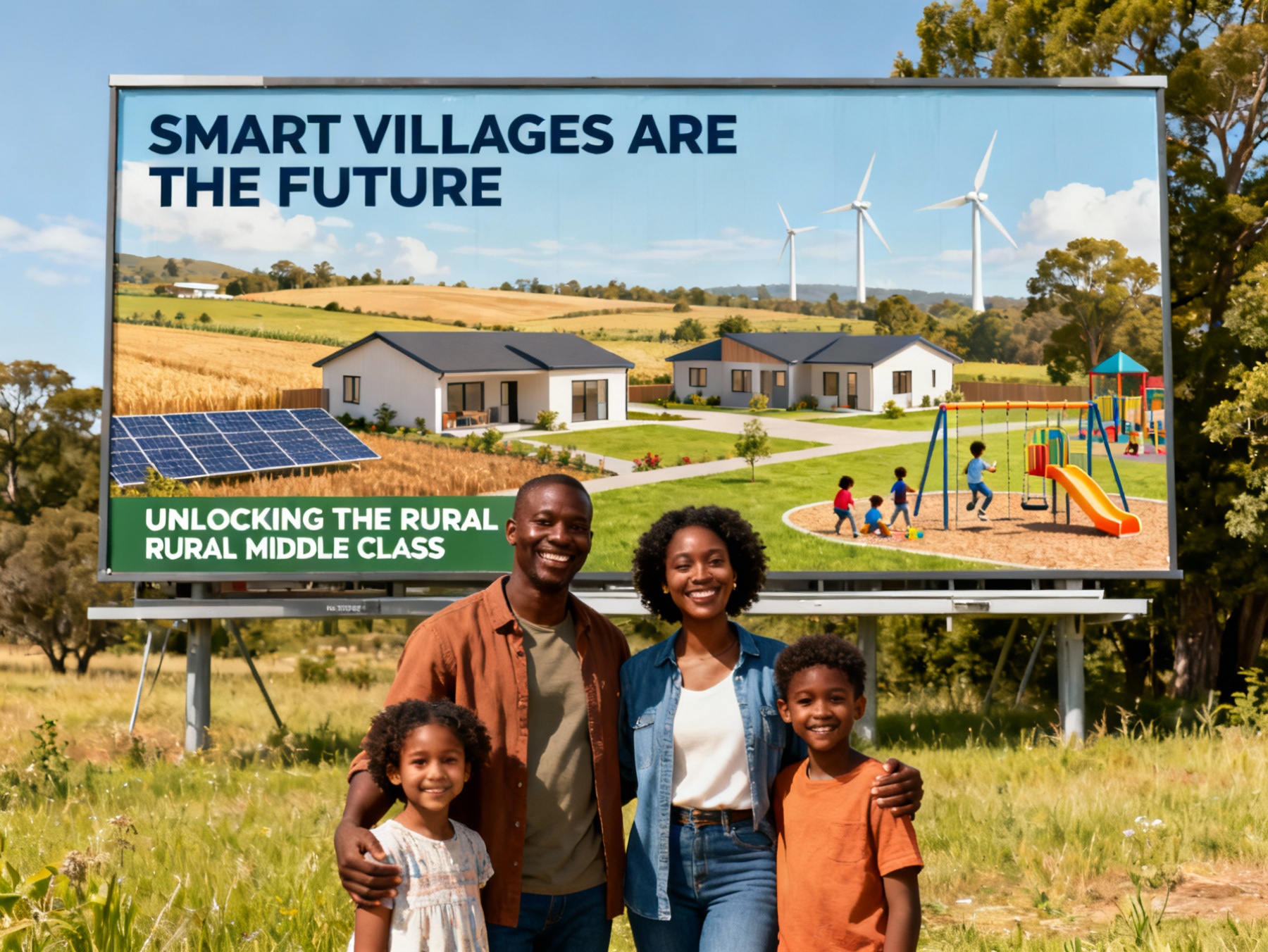
Each Smart Village Includes
Clean Water System
Reticulation with metered, reliable, and maintained supply
Renewable Energy
Solar PV + batteries with smart metering and prepaid options
Quality Infrastructure
All-weather internal roads and street lighting for safety and access
Digital Connectivity
High-speed internet and community safety platforms
Planned Residential Stands
Approved house plans and build controls for quality
Cooperative Governance
Homeowners cooperative for fair, transparent local governance
Productive Agriculture
Co-op agriculture and agri-business, plus space for micro-enterprises
Community Facilities
Sites for schools, skills hubs and local commercial centres
Commercial Development
Flexible spaces - build a mall, lodge, or other enterprises based on demand
From Traditional Village to Smart Village
Traditional Village
- Limited or no electricity
- Walk kilometers for water
- No internet connectivity
- Limited economic opportunities
- Fragmented development
Smart Village
- 24/7 renewable energy with smart metering
- Metered water reticulation to every home
- Digital connectivity and safety platforms
- Built-in jobs and business opportunities
- Master-planned with cooperative governance
Ready to Experience Africa's First Smart Village?
Qokolweni Smart Village is making this vision reality. Join the 2,000+ people who've already chosen their future.
Built to Work With Government,
Not Around It
Smart Villages™ is not a bypass of municipal or traditional authority. It is a structured, legally-sound partnership that enables municipalities and government departments to finally deliver what communities have been waiting decades for — without depleting their budgets.
The Unspoken Crisis on Communal Land
Across South Africa, millions of hectares of communal and municipal land sit under-serviced. Municipalities inherit these areas from apartheid-era boundaries but lack the capital, capacity and legal frameworks to fully develop them.
The result: communities wait 30 years on housing lists. Young people leave. Infrastructure collapses. The rates base shrinks. The cycle deepens.
Who Smart Villages™ Partners With
Each level of government plays a defined role in the Smart Villages™ partnership framework — creating shared accountability and shared benefit.
Local Municipality
Provides land rights, town planning approvals, and zoning. Smart Villages™ delivers the services the municipality cannot fund — at zero capital cost to the municipality.
Traditional Authority
Traditional councils unlock communal land for structured development under IPILRA and TLGFA frameworks. Chiefs and headmen remain central governance partners throughout.
Provincial Government
Provincial departments of Human Settlements, Agriculture, and Economic Development co-fund bulk infrastructure and prioritise Smart Village™ projects in IDPs.
National Departments
COGTA, DRDLR, DHS, DWS and DALRRD align programmes, grants and technical capacity to Smart Village™ rollouts — turning siloed budgets into integrated delivery.
What Government Gets From the Partnership
Smart Villages™ is designed to create measurable, reportable wins for every sphere of government involved.
Unlocking Foreign Direct Investment
In addition to municipal and government budgets, Smart Villages South Africa actively assists in attracting foreign direct investment — bringing in capital that would otherwise never reach communal or municipal land.
Expands the Municipal Rates Base
Every new serviced stand creates a rateable property. Hundreds of households mean a meaningful, long-term increase to the municipality's revenue without any upfront spend.
Offloads Service Delivery Backlogs
Water, energy and roads are built, operated and maintained by the Smart Village™ cooperative — removing perpetual O&M burden from already-stretched municipal budgets.
Employs Local Residents
Construction, operations, agriculture and commerce create jobs within the ward. Employed, housed residents reduce pressure on social services across the municipality.
IDP and SDBIP Ready
The Smart Villages™ model is structured to slot into Integrated Development Plans and Service Delivery and Budget Implementation Plans with measurable milestones.
Supports National Audit Outcomes
Transparent cooperative governance, prepaid metering and audited financials help municipalities demonstrate service delivery progress to the Auditor-General.
How the Partnership Is Structured
A clear, step-by-step process from first engagement to a fully operational Smart Village™.
Engagement
Smart Villages™ initiates formal engagement with the municipality, traditional council and relevant provincial department.
Land Assessment
Technical feasibility of the site is assessed — zoning, servitudes, bulk infrastructure proximity and title arrangements.
MOU & Agreements
A Memorandum of Understanding is signed. Land use agreements, cooperative formation and bulk services MOUs are concluded.
Development
Smart Villages™ secures capital and begins phased construction. Municipalities and DHS may co-fund bulk services.
Handover & Growth
The homeowners cooperative takes operational ownership. Revenue flows back to the community and the municipality's rates base.
Is Your Municipality Ready?
If your municipality or traditional authority has under-serviced land and a willing community, Smart Villages™ can turn it into a thriving, self-sustaining settlement — at no capital cost to you.
Aligned to National Policy.
Supported by Every Sphere.
Smart Villages™ is not a standalone initiative. Every element of the model is designed to unlock, activate and align existing government programmes, budgets and mandates — creating a multiplier effect that neither government nor the private sector could achieve alone.
Government Departments We Engage
Smart Villages™ unlocks funding and capacity from across the state — cutting through departmental silos to deliver integrated results.
Municipal capacity, traditional authority integration, ward-level development coordination.
Land tenure formalisation, IPILRA compliance, rural infrastructure grants and CRDP programme alignment.
Housing subsidies, USDG / HSDG bulk infrastructure funding and breaking new ground for rural settlements.
RBIG and MIG-funded bulk water schemes, sanitation norms, and regional bulk connections.
REIPPP alignment, municipal distributed generation licensing, and off-grid energy regulatory compliance.
Agri-parks, CASP grants, cooperative enterprise registration, and irrigation infrastructure.
SEDA incubation, SEFA finance facilities, cooperative support and local procurement set-asides.
School infrastructure provisioning, ASIDI programme, and adult literacy & skills hubs.
Aligned to Key National Policies
Every Smart Villages™ project is structured to be measurable against national and provincial policy commitments.
National Development Plan 2030
Smart Villages™ directly advances NDP Chapter 6 goals — rural transformation, sustainable livelihoods, and spatial equity between urban and rural South Africa.
Integrated Urban Development Framework
The master-planning approach, cost-recovery utilities and cooperative governance align with IUDF principles extended to rural and peri-urban nodes.
Medium-Term Strategic Framework (MTSF)
Smart Villages™ delivers on Priority 1 (Economic transformation) and Priority 4 (Spatial integration and human settlements) of the MTSF targets.
IPILRA & TLGFA Compliance
The model respects the Interim Protection of Informal Land Rights Act and Traditional Leadership and Governance Framework Act at every stage of land engagement.
Municipal Systems Act
Service delivery agreements, cooperative billing and infrastructure handover protocols are designed to be fully compliant with the Local Government Municipal Systems Act.
Green Economy & SDGs
Renewable energy, circular agriculture and digital infrastructure directly advance SDG 1, 6, 7, 8, 11 and 13 — strengthening DFI and development bank funding eligibility.
What Land Is Eligible?
Smart Villages™ works across multiple land tenure types. If the land is under-serviced and communities are waiting, it qualifies.
Communal Land
Traditional authority land held under IPILRA, managed through tribal councils and headmen. The most common land type in Eastern Cape, KZN and Limpopo.
Municipal-Owned Land
Vacant or under-developed municipal land that appears on the municipality's asset register. No traditional authority involvement required.
State-Owned Land
Land held by national or provincial government through entities like Ingonyama Trust, DRDLR or the DPW — often the largest contiguous parcels.
Informally Occupied Land
Areas with existing informal occupation where rights need to be formalised, residents reblocked, and services introduced without displacement.
Anchored in Core Values
Smart Villages are built on three fundamental principles that ensure modernization strengthens rather than weakens our communities
Dignity
Every resident deserves modern amenities and infrastructure that honors their worth and potential.
Youth Empowerment
Creating opportunities for young people to thrive without leaving their communities behind.
Ecological Integrity
Sustainable development that works with nature, not against it, preserving our environment.
What Makes a Village "Smart"?
Modern infrastructure and services that transform rural life while preserving community values
24/7 Solar Power
Reliable, clean energy that never runs out, powering homes and businesses around the clock.
Clean Running Water
Safe, accessible water supply directly to every home, ending long walks to distant sources.
High-Speed Internet
Fast, reliable connectivity that opens doors to education, business, and global opportunities.
Thriving Farms
Modern agricultural techniques and technology that boost productivity and food security.
Attractive Homes
Beautiful, sustainable housing that combines modern comfort with cultural aesthetics.
Economic Opportunity
Local businesses, markets, and enterprises that create jobs and wealth within the community.

Strengthening Cultural Heritage
Smart Villages are designed to strengthen the social fabric, ensuring that modernization does not uproot our culture or environment.
We preserve cultural heritage while providing the amenities and services of a future-ready town, creating spaces where tradition and innovation work hand in hand.
Traditional governance structures integrated with modern systems
Cultural centers and spaces for community gatherings
Local languages and customs celebrated alongside technological progress
Ready to Experience Smart Village Living?
Join the Qokolweni Pilot Village and be part of the rural transformation that preserves culture while embracing the future.